

You are in the shower, just washing your hair like you do every single morning. You are thinking about your "to-do" list or what you want for breakfast. Then, you look down at the drain.
There is a clump of hair sitting there. It looks like a small, wet bird. You look at your hands, and there are more strands tangled between your fingers. Later, you check your hairbrush, and it is full of hair you just cleaned out yesterday.
You probably do what most women do: you start touching your ponytail to see if it feels "thinner." You go to the mirror and check your part line. Then, you spend the next three hours on the internet looking for "the best hair growth gummies" or "magical serums."
It is scary. It feels like you are losing a part of yourself. Most women start panic-buying every bottle they see on social media without ever stopping to ask why the hair is leaving.
If you want to stop the shedding, the guessing has to end. Throwing random vitamins at a problem you don't understand is just a waste of your time and money. Sometimes, it can even make things worse.
Here is exactly how a doctor looks at hair loss in women, and the simple, science-backed steps to get your hair back on track.
The "Energy Budget": Why Hair Leaves
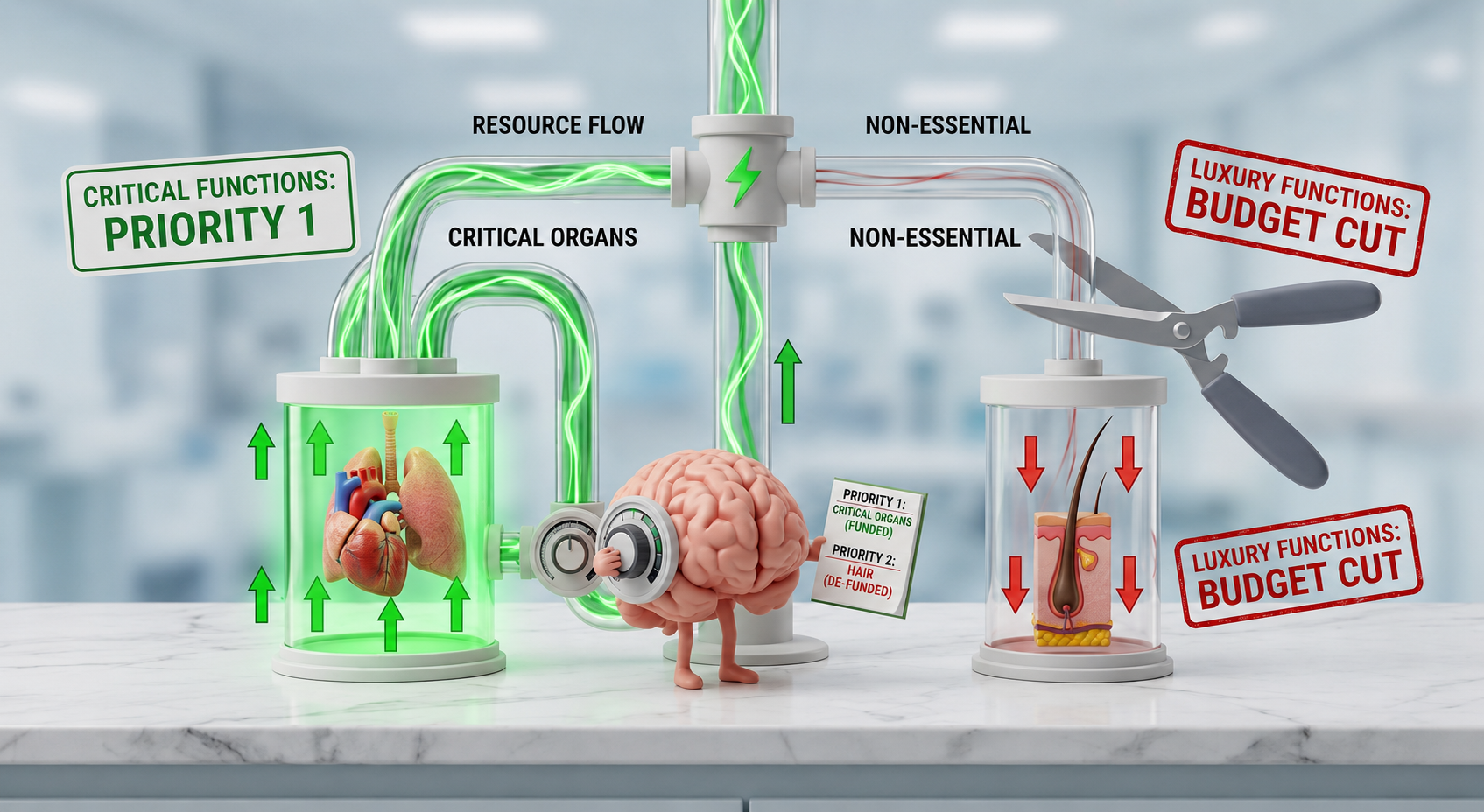
To understand hair loss, you have to think about your body like a bank. Your body has a "budget" of energy and nutrients. It uses that budget to keep the "important" things running—like your heart, your brain, and your lungs.
Hair is like a fancy luxury car. It is nice to have, but your body doesn't "need" it to survive.
When your body feels stressed, sick, or low on "money" (nutrients), it makes a choice. It cuts the budget for the luxury items first. It shuts down the "hair factories" to save energy for your heart.
Doctors usually put these "budget cuts" into three simple categories.
1. The "Hormone Boss" (Internal Control)
Think of hormones like the "Boss" of your body. They tell every part of you when to work and when to rest. Sometimes, that Boss gets a little confused.
This happens most often after a big change—like having a baby, starting or stopping a medication, or as you get older. When the Boss sends the wrong signals, your hair follicles think it is time to take a very long nap. This is why many women notice their hair getting thinner at the top or the front of their head.
2. The "Emergency Shutdown" (The 90-Day Delay)
This is a very specific type of hair loss. Imagine your body goes through something big. Maybe you had a high fever, a very stressful month at work, or a surgery.
Your body goes into "Emergency Mode." It stops growing hair instantly to save power. But here is the tricky part: your hair doesn't fall out right away. It takes about three months for that hair to actually let go and fall out.
If you are losing clumps of hair today, think back to what happened to you three months ago. That is usually the real culprit.
3. The "Empty Fuel Tank" (Hidden Deficiencies)
Your hair follicles are some of the fastest-working parts of your body. They are like tiny athletes. To run fast, they need the best fuel.
Many women are running on an "empty tank" without even knowing it. The two biggest things they are usually missing? Iron and Vitamin D.
If your "fuel tank" is low, your hair will grow in weak, thin, and brittle. It might even just stop growing entirely because there isn't enough "gas" to keep the factory moving.
The 10-Second Mirror Test
Before you buy another bottle of "hair growth oil," I want you to do a simple check. All you need is a mirror and a comb.
Step 1: The "Widening River" Check
Part your hair right down the middle. Look at the "white line" of your scalp. Now, part your hair on the side. Does the "line" look wider than it used to? If the skin of your scalp is starting to peek through more than before, your "hair factories" might be getting smaller and producing thinner hairs.
Step 2: The "Shrinking Ponytail" Feel
Grab your hair like you are going to put it in a ponytail. Does it feel like you have to wrap the hair tie around one more time than you used to? If your ponytail feels "squishy" or thin, you are likely losing hair from all over your head, not just one spot.
Step 3: The "Bulb" Test
Look at the hair that has fallen out. Does it have a tiny, white "bulb" at the end? If it does, that is actually good news! It means the hair fell out in its natural cycle. If the hair is broken and has no bulb, it means your hair is snapping off because it is too weak or dry.
How to Actually Fix It
Treating hair loss with a "one-size-fits-all" shampoo is scientifically impossible. Once we find the root cause, the solution is usually very straightforward.
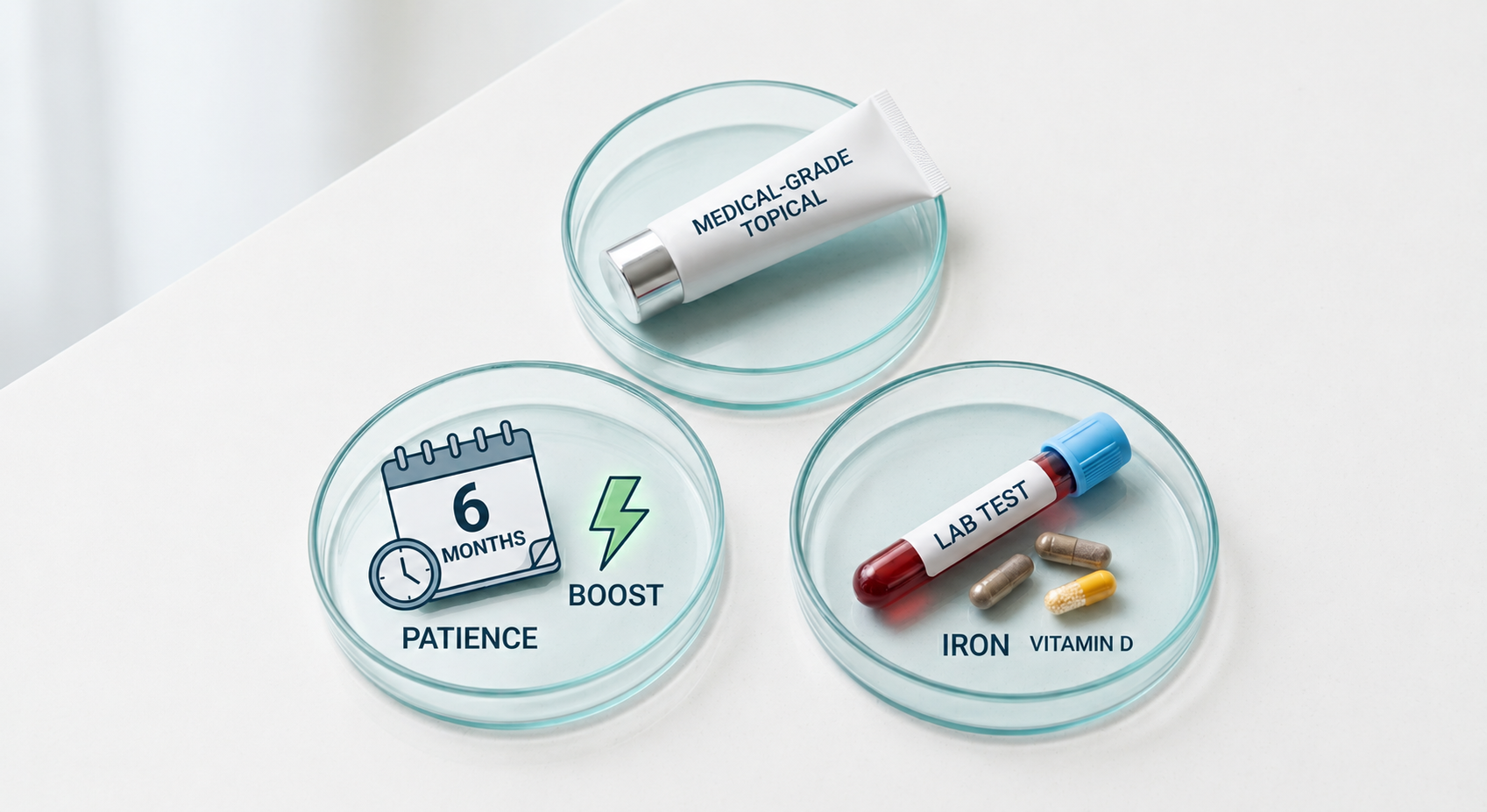
If it is the "Hormone Boss": We use medical-grade treatments that talk directly to the Boss. These treatments tell the hair follicles to ignore the "nap" signal and stay in the "growth" phase for longer.
If it is the "Emergency Shutdown": The best medicine is actually... patience. If the stress is over, your hair will usually start growing back on its own in about six months. However, a doctor can give you a "boost" to make it happen faster.
If it is the "Empty Fuel Tank": We don't guess. We test. A simple blood test can tell us exactly what your body is missing. Taking the right vitamin is like finally giving your car the high-quality fuel it needs to win a race.
The "Truth Bomb" About Gummies
The colorful hair gummies look fun and taste like candy. But here is the truth: unless you are actually missing a specific vitamin, those gummies won't do much.
In fact, taking too much of some vitamins (like Vitamin A) can actually cause more hair loss. Don't let a social media ad be your doctor.
When to Stop Guessing

Hair loss is a journey, but you don't have to walk it alone. The biggest mistake most women make is waiting until they can see their scalp through their hair before asking for help.
The earlier you start, the more hair we can save. Think of it like a fire—it is much easier to put out a small candle than a whole building. Once a hair follicle has been "closed" for many years, it is very hard to wake it back up.
Booking a quick dermatologist online consultation with a professional takes the stress out of the situation. You don't have to spend hours searching the internet for answers that might not be true. Instead, you can talk to an expert who can look at your history, identify your specific "bucket," and give you a plan that actually works.
You deserve to look in the mirror and feel like yourself again. Let’s get your "hair factories" back to work.